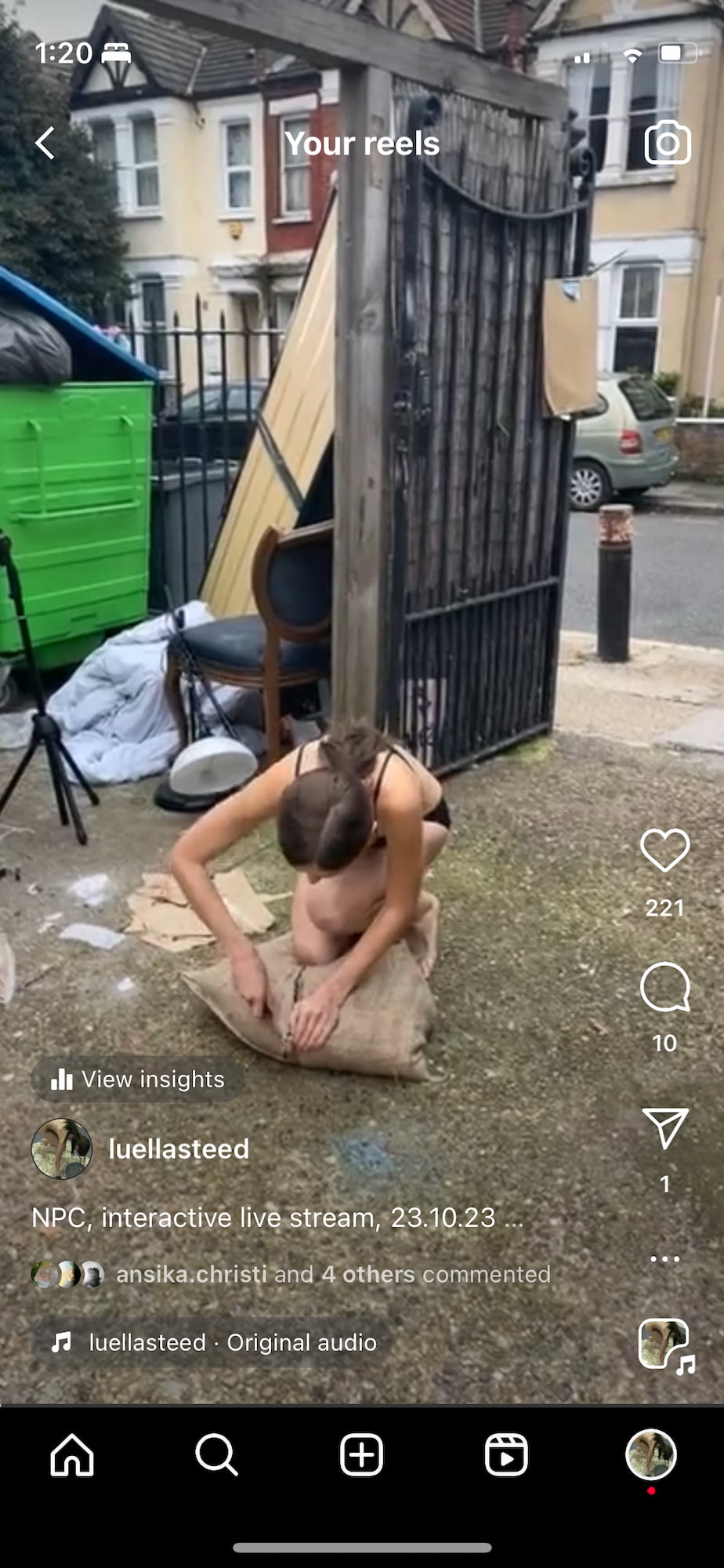
Luella Steed is a 22 year old multi-disciplinary artist who specialises in performance, illustration and sculpture. I first met Luella whilst walking the same runway in 2022 and have watched her from afar develop into one of the most promising artists the contemporary London scene has to offer. Her work, centred around a kind of visceral dedication to human connection, is vulnerable, often confusing and terribly unique. At its hearts it invites her audience, at least in my opinion, to play, to laugh but most importantly to pay attention. Through her work we see reflected back at us the fragmented oddities of the social and (un)natural world around us, its unlikely collisions and provocations. Her use of live streaming as a medium for performance is as equally brilliant as it is distinct, and represents a truly affective example of the nuanced creative potential new forms of technology can offer the arts. After taking a year out to work on scenic painting in the film industry, she is about to begin her third year at CSM. We talked openly and honestly about her influences, her choices of form and her aspirations for the future.
1. What drew you to the medium of performance art?
I was attracted to performance art because it really bridges the gap between the artist and the audience. I’ve always been interested in the ways that people communicate, and I think I’ve always been searching for connection and a kind of relatability through my practice in general. Although its kind of hard to pin down, and even harder not to give an answer that’s just something surface level - like I make the art I do just because I do or because its cool - because ultimately that’s true as well. I feel like each step of my artistic journey so far has increasingly lead me towards performance art, and I guess essentially I’ve always really felt like my art is a reflection of me, so it only made sense for me to actually be some of the work too.
Performance art provides an immediacy for that that you can’t be found in the same way in other mediums.
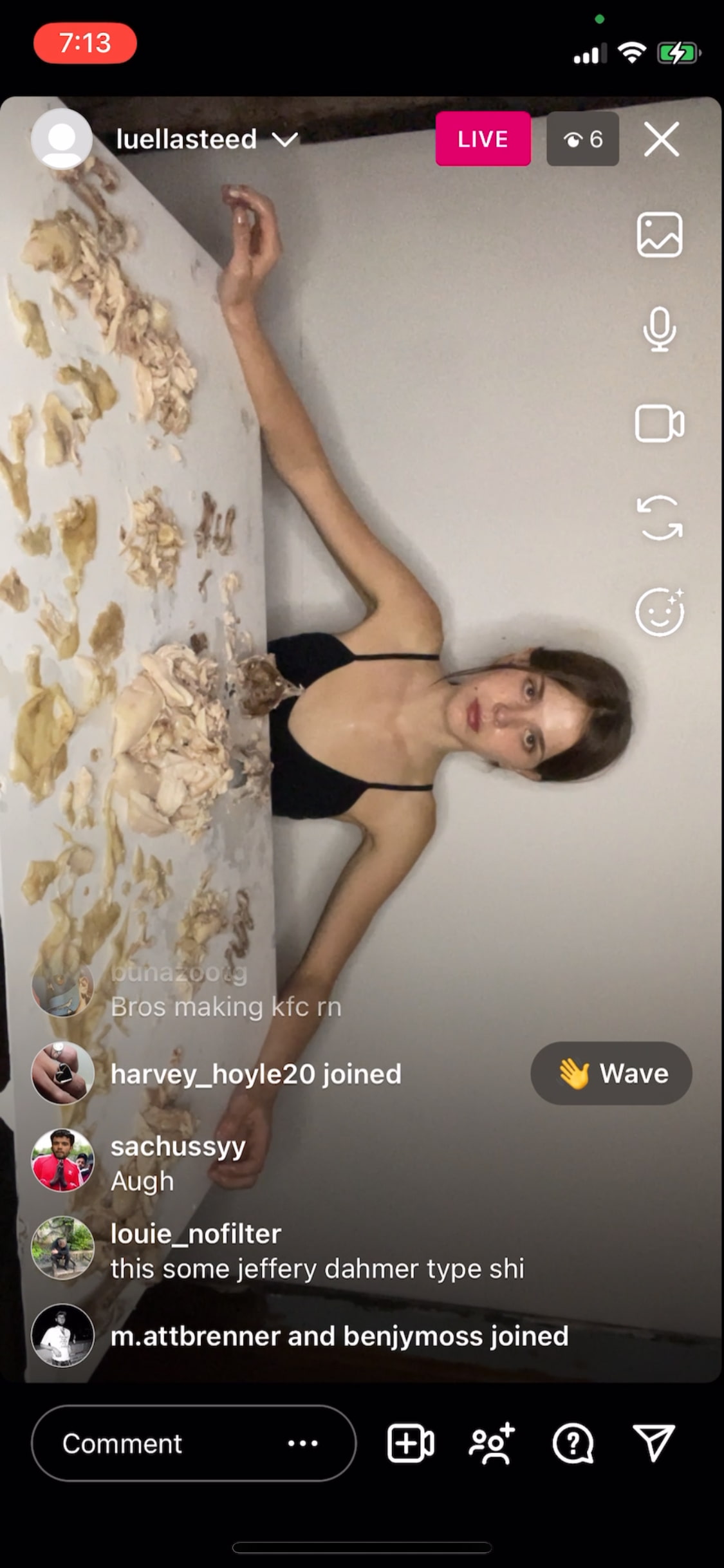
2. One of your live stream performances involved you on a road in London dragging a bag of sand, where viewers were able to comment and command your movements. How do reactions or the anticipation of reactions from the public shape your performances?
That specific performance I didn’t really think about it, honestly just because of how London people are. In terms of like, if you see something weird on the street you just fucking walk past it. I feel like if it was somewhere like Kent or something, people would probably have had something to say, and then I probably would have thought about it a bit more. In London I don’t think anyone really cares if you’re doing crazy shit on the street. I’m also always open to things going wrong or changing, and I think with performance whatever happens, whether you plan for it or not, it just becomes absorbed into part of it. In that way performances can never really go wrong. I try not to get fixated on certain outcome because there’s a lot of times where it comes out so different from what I imagined. You obviously need some parameters based on an idea or subject, but I don’t want to be micromanaging everything that’s happening. Performance is a super fluid medium and I kinda want to keep it that way.
3. One thing that really drew me to your work is your use of live streaming as a medium for performance. How has technology inspired or moulded your work?
I mean, so much, so much. As a teenager I grew up in Cornwall, completely in the middle of fucking nowhere (literally in a place called the forgotten corner,) where I was so submerged in nature, but at the same time I had this really, really strong online presence and involvement with the internet. It’s a super stark contrast that I realised is a bit like a double life with those two things constantly contradicting. A big part of it is also having unfiltered internet access from a very young age - that definitely shaped me a lot too. I feel like we are reaching a super interesting point where people are actually beginning to take a step back and observe how intensely involved we are with technology. Its like the way we talk, the way we act, how we interact with each other – porn for example has shaped everyone so much and I feel like we’re only kind of now just getting to the point where we are like, whoa, what the fuck? and really starting to pay attention to the after effects of the immediate access of the internet. I’m not even saying necessarily either terrible or amazing, its way more complex than that: but it is was it is and what it’s interesting.
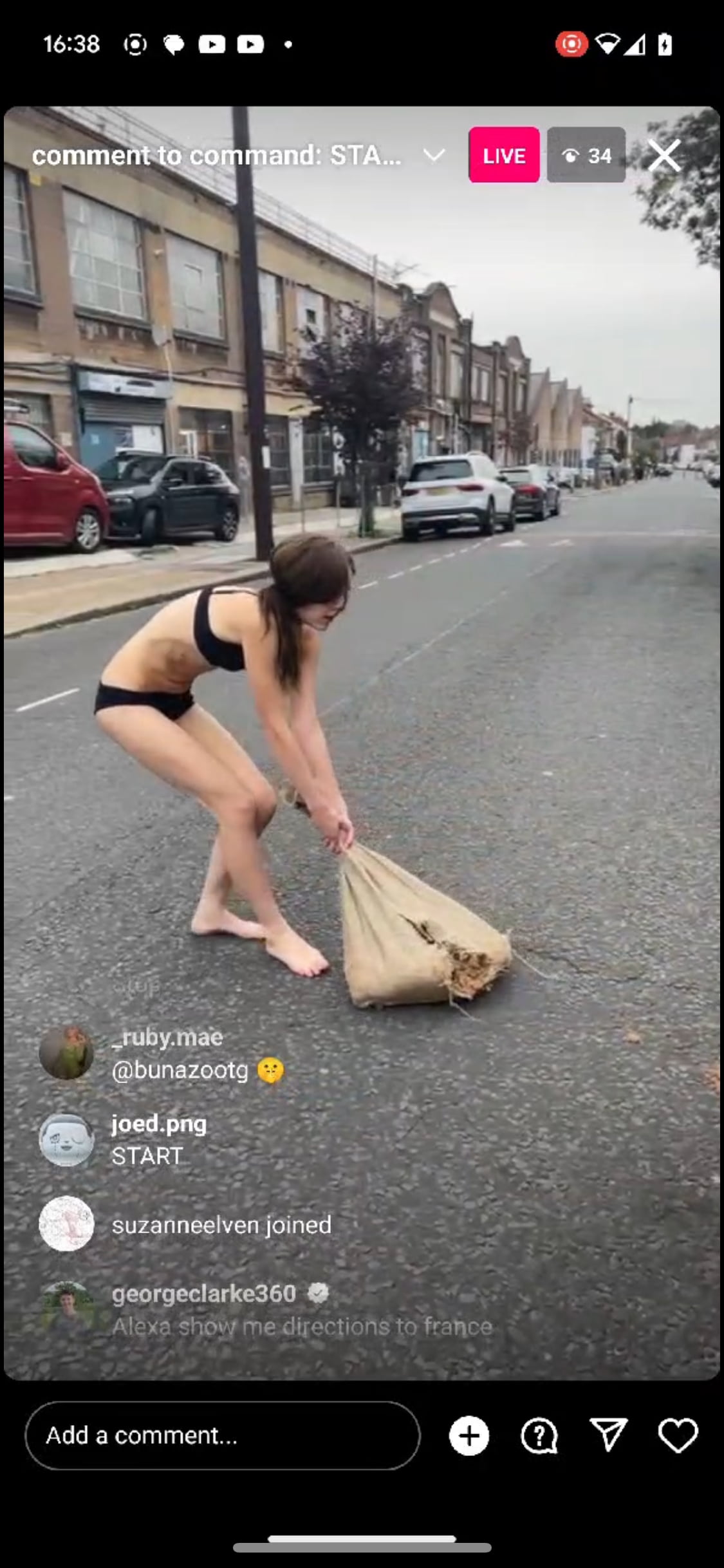
4. A lot of your work, specifically of your sculpture ‘daddy’ and your live stream performance “To the Bone’ where you eat a boiled chicken, have a strong visceral aspect to them and self-referentially play with the grotesque. Is that a big part of your intentions for your work?
I think a lot of people think that I’m really intending to shock people, but I don’t really feel that way, which is interesting. Shock is definitely a common reaction to my work but in all honesty the stuff I make feels like quite a primal thing to do and a lot of it is based off intuition. The ideas I have I don’t always quite know where they come from, so I’m not going to pretend like I’m sitting here plotting to make the most disgusting piece of art ever, its more of a real instinct and urge just to make something. In the same breath though, with the grotesque, I have quite a strong relationship with death in terms of a lot death in my family throughout my life, so I think that’s possibly where that seed kind of comes through. I do reflect on my work a lot and especially in relation to critical theory and its various contexts, but I wouldn’t say its mixed too much with my intentions for a piece beforehand.
5. Alongside from technology, what or who are you artistic influences? Are there specific artists you pay attention to or do you tend to draw inspiration more from ‘real’ world phenomena?
I would say more of the real world. To be honest, I don’t actually really look at other artists too much. A lot of the performance ideas I get are from walking down the street or something weird I see that sticks in my mind. Even with the online space, the stuff that stays with me is more about seeing the aftermath in the real world rather than seeing things online directly. Although its still definitely important to understand the artistic context that you are creating within or contributing to, I will say most of my favourite artists are actually just my friends and the people I’m directly surrounded by. Its not even that they are making similar work to me, I think its just super important to be surrounded by other artists so that you aren’t making work entirely in a vacuum separate to the rest of the world. Whatever the fuck the art era is right now, I mean I have no idea, there’s some super exciting stuff happening amongst the sediment of chaos – weirdly I feel like right now is actually a really good time for art and I think over the next few years we are going to see some great people coming through. We are in a period where every week there is some new ‘core’, trend or niche, and everything is so much more individualistic. That obviously has its negatives, but its also creating the space for the weird and the wonderful to seep through and find an audience.
6. You are about to enter your third year at CSM. What are your experiences of art school so far and has it helped or hindered your trajectory as an artist?
CSM has like tested me in ways that I didn't think it would. Its exposed the fuck out of me, broke me down and then kind of built me back up again. There’s actually no other place like it, and I don’t even know how to describe it. I’ve really struggled there and then I’ve also had some really good times there too. Everyone has their ebbs and flows at university but I think its less about that and more about a general social feeling. I’m an emotional sponge so I literally absorb everything that’s going on around me and there’s this heavy weight there about being the most individual, the most unique, the most woke but not too woke, caring but not caring too much etc etc. – there’s so many layers to the expectations everyone has around you. It’s weird and convoluted but at the same time it forced me to get to the point of being like, actually no, I’m just going to do whatever the fuck I want regardless.
7. What’s next for you?
I want to do more impromptu exhibitions in public spaces. I’m working on a project at the moment which basically involves having a kind of picnic/barbeque that’s also an exhibition and a performance, and so I’m looking forward to creating smaller more organic spaces with people. I did a performance in February where I realized that I actually don’t like exhibiting in art galleries. I actually kind of hate it. The way they are set up instantly makes people feel uncomfortable or like they should know something they don’t, or even alternatively that they know more than they actually do. When you perform in those kind of spaces you get people coming in stroking their beards looking all deeply and authoritatively at what’s happening and that’s not how I want people to interact with my work. I’m not trying to make anyone think about something in a specifically intellectual way, if they do that’s great, but I want to encourage the point of view that all responses to my work are equally valid. I want people to connect with the work I make on a human, primal and intimate level, and I don’t feel like the art gallery space facilitates that. Instead, I’m looking at how I can incorporate public, natural, and comfy spaces into the next few pieces I do.