1. Throughout your final collection, you worked with sustainable fish leather. What drew you to that choice, and how do you approach sustainability in your work?
I have always been drawn to sustainability. I’m not a fan of PU leathers, as in my opinion, they are essentially plastic — something that will only harm the environment in the long run. I support leather as long as it comes from a place of consciousness and is used as a by-product. The meat industry is a global, ongoing phenomenon, and instead of allowing its by-products to go to waste, we can give them new purpose.
Qaya is an ethical leather company based in Peru. They produce fish leather exclusively from waste generated by artisanal fishing. Their tanning process uses natural, non-toxic dyes.
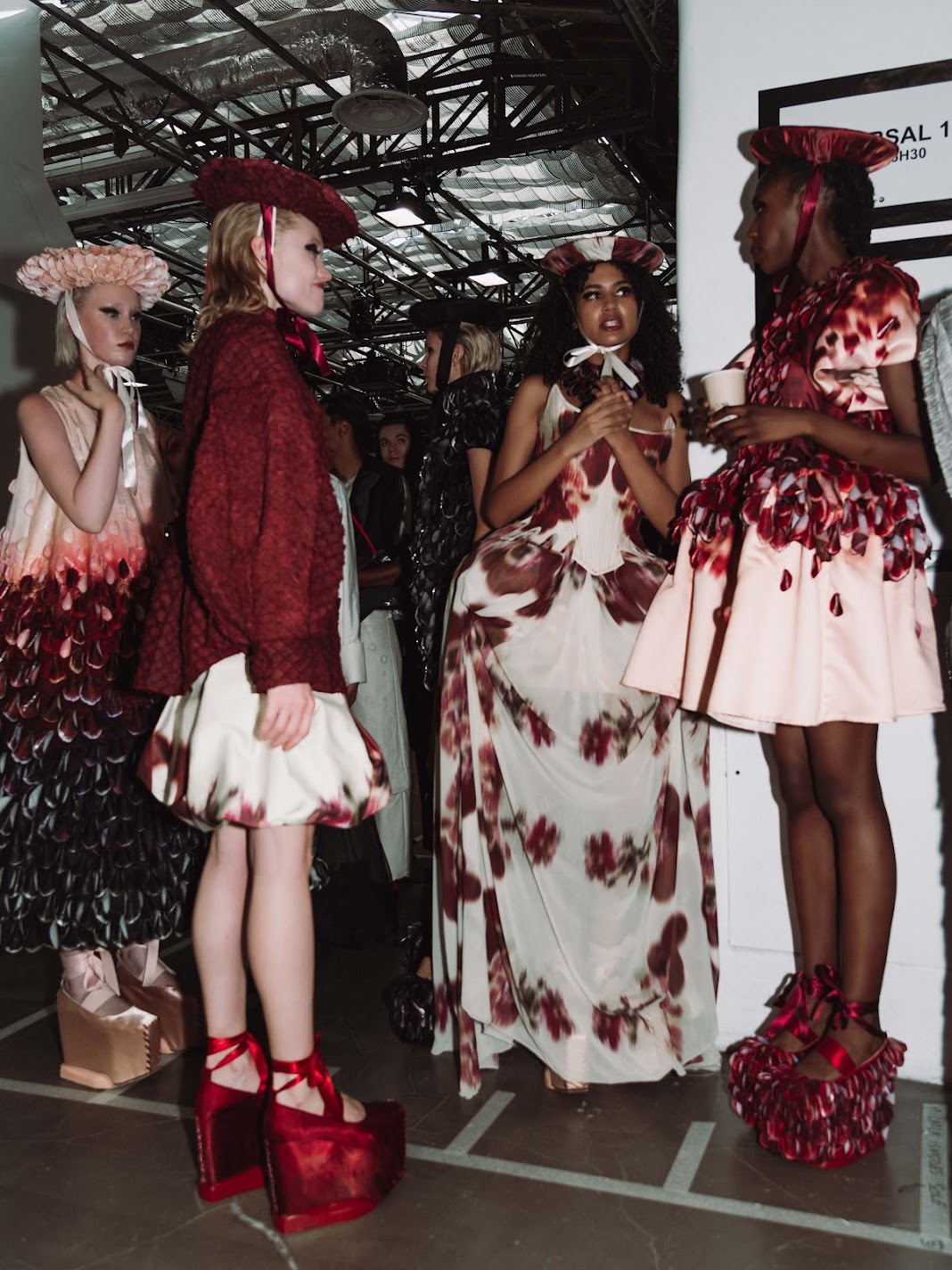
I chose fish leather for my collection because it created a smocked, fabric-like effect with a slightly unsettling texture — it became the missing puzzle piece that tied the collection together.
2. What do you think your work reveals about your perspective or personality as a designer?
My work reveals my feminine DNA and my love for soft silhouettes — like puffy sleeves or floral prints — but it also unveils the darker side of me that I don’t usually show in everyday life. I’m obsessed with horror movies and deeply fascinated by true crime, gore, and everything unsettling. There’s a lot of vulnerability in my concepts. These films have always inspired me, and fashion is the way I express and explore that weird, eerie side of myself.
3. Who or what are the main influences behind your work?
In terms of designers, definitely Alexander McQueen. His collections were raw and made people feel unsettled — something I deeply admire. He was a genius. His manipulation of shape and texture was pure artistry.
On the more feminine side, I’m influenced by Simone Rocha and her approach to delicate fabrics, lace, frills, and soft silhouettes.
I’m also inspired by classic horror films like Suspiria and The Shining, as well as psychological horror like Midsommarand Hereditary. The mood and visual atmosphere in these films have had a strong impact on my work.
4. You’re very proud of your Peruvian heritage. How does it influence your creative decisions or visual language?
Definitely. I feel like all Peruvians grow up with a deep love for our culture. We have so much to offer — especially in terms of textiles — and there’s so much to learn from our ancient weaving and dyeing techniques. I wanted to incorporate elements of my culture in a subtle yet meaningful way.
For example, the Peruvian monteras are traditional flat, plate-like hats worn in Cusco, often seen in bright colors. In my collection, the hats were carefully designed to match each outfit. I also featured orchid prints throughout, representing the immense variety of orchids found in the Peruvian rainforest. They add a feminine, romantic, yet eerie touch to the pieces.
I used hand-dyed paiche fish scales — a by-product from fish farms that raise fish solely for human consumption. These scales and leather pieces were given a second life to create unique textures and to replace commonly used, yet highly polluting, plastic paillettes.
5. What are your next steps, or what would you like to explore in the future?
I love learning from other people, so I’m definitely looking forward to working with designers I admire and growing through collaboration. In the future, I hope to create my own brand. I plan to continue drawing inspiration from Peru and work hand-in-hand with indigenous communities — they’re truly inspiring and carry forward the ancestral knowledge and techniques that I want to celebrate through my work.